.png)
How we worship
Visiting a new church can be intimidating.This guide helps you see some of what we do and why.
Traditional Worship?
Most people assume that only casual, spontaneous and emotional action is sincere, but this is not true. God calls for reverence in worship (Hebrews 12:28), AND He wants genuine heart worship. We are as
imperfect and broken as anyone else - we want to be honest about that, and welcome your challenges in our midst, too! But we also want to honor God visibly in our life together. We seek worship that befits the greatness of the occasion: meeting with our majestic God.
Children in Worship?
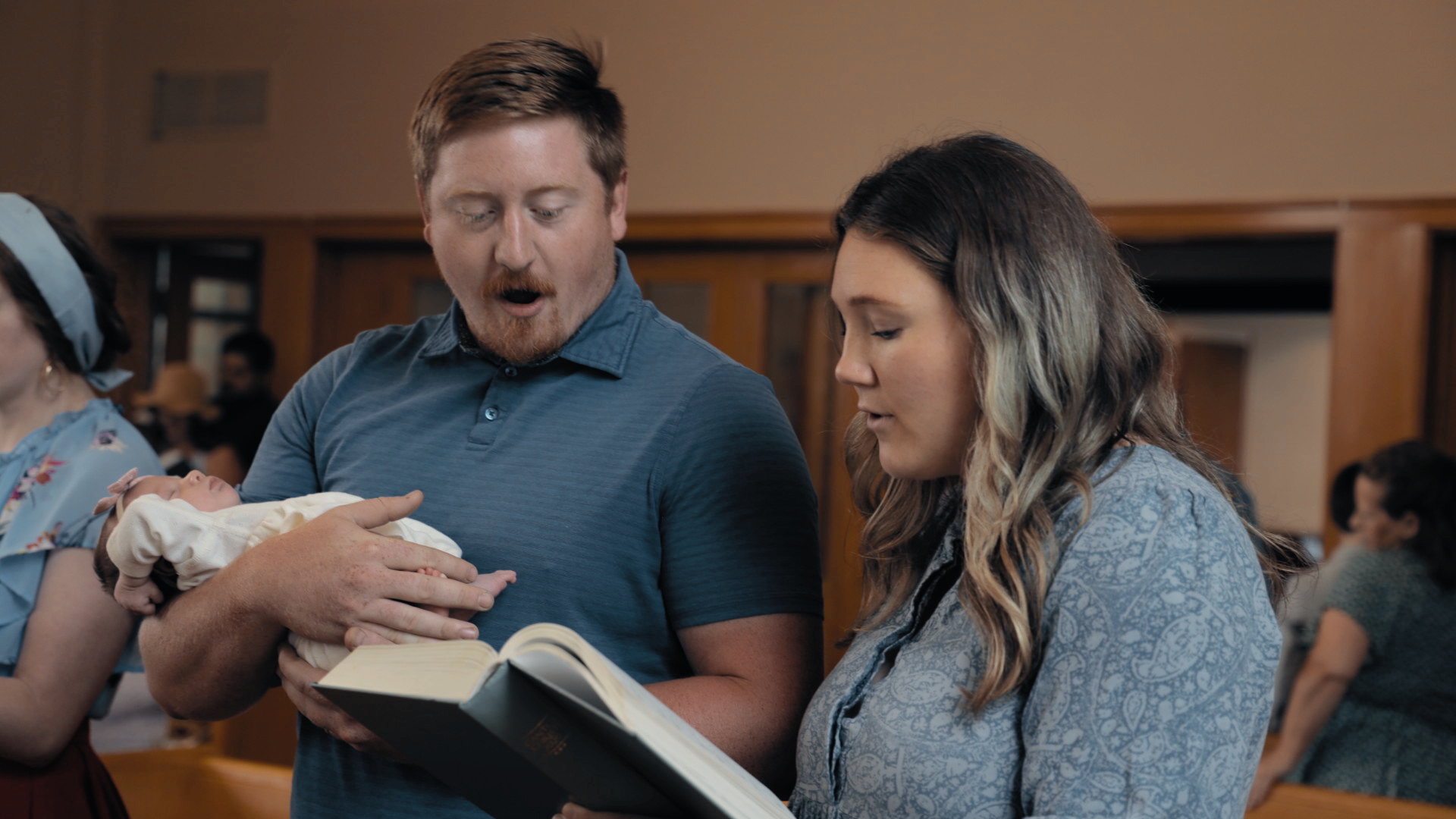
YES! We invite children of all ages to participate with us for the whole worship service. This nurtures their sense of belonging and commitment to Jesus. “Let the little children come to Me,” Jesus said! We are very understanding of the noises that little ones inevitably make in worship. It takes patience to train them to focus on and take part in worship. It is worth the effort! When needed there is space to take aside a noisy child.
Nothing for my Kids?
Our children are fed spiritually the same way we are as adults - in worshiping God together. We provide classes before or after worship as the Lord leads and provides for that. But don’t expect to drop your children off for a fun time while you do “real church.” Your kids need to see you worship God. They learn how to worship at their parents’ side. Our goal is for our children to appreciate mature worship, even if they don’t grasp it all yet. God wants us to praise Him and learn together, young and old (Psalm 148:12).
Where’s the screen?
We are committed to a service of worship and music that does not overly rely on a music leader or band, but puts the order of the service and the music in the hands of every worshiper to have for themselves. We believe this helps us all participate in the whole worship service, as the Reformers intended, instead of watching a priest or a praise band perform. Please pick up a bulletin and a hymnal and you’ll be ready to go!
I don’t know this music. What do I do?
The same thing we do when new music is introduced at church. Follow along, learn the melody quietly until you feel confident enough to sing. We know we go against the grain of most churches in music style.
This is purposeful. We believe it is better for us to search out the best that the church has sung for the last 1800 years, not just the last eight. Experience the rich treasure of singing Psalms & time-tested hymns.
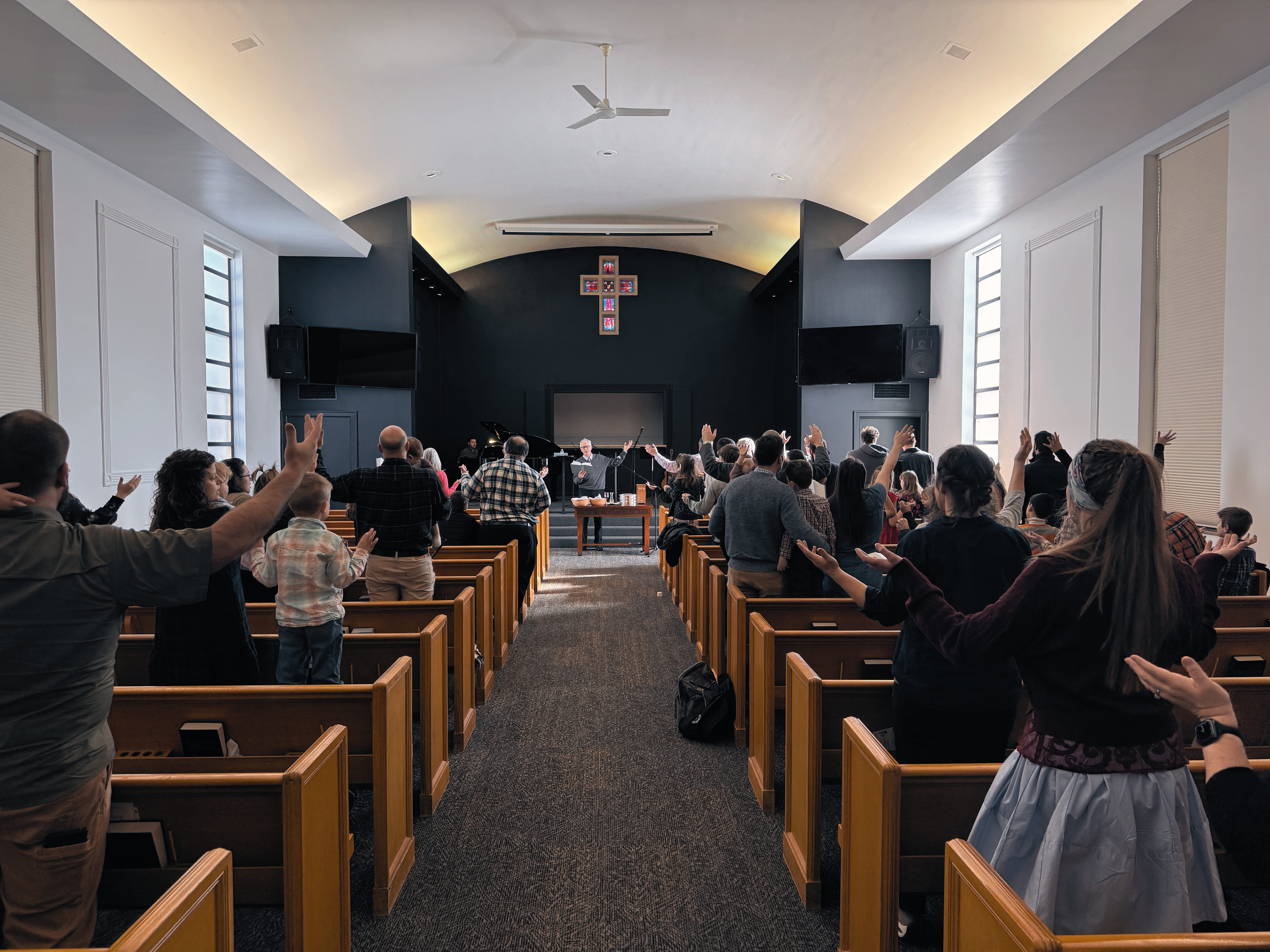
Why do you kneel for confession and raise hands for some songs?
We believe God wants us to participate fully in worship, including with our bodies. We kneel to express our humility before God (Psalm 95:7). We raise our hands to express lifting our hearts and our souls to God in praise and prayer (1 Timothy 2:8; Psalm 134:2).
Do I Need to Give Money?
As a visitor, please do not feel obligated to give. We do not “pass a plate” but have an offering box near the bulletins and hymnals as you enter. We bring it forward during the service, and you can always give after the service into the same box on the communion table.
What is Communion?
Every week we eat bread and drink wine, following the direction of Jesus the night before He went to the cross. The Lord’s Supper is taken as an act of faith in Christ’s death to pay the price for our sins. It is an important way God connects with His people. If you are not a baptized Christian, so are not taking the bread and wine as they pass, use the time to consider the Scripture readings, prayers, sermon, hymns sung, etc.
Why do you have wine in communion?
We believe wine was the element Jesus used to institute Communion, and what He wants us to use today.
FAQs
The Reformed Church believes that ethics are grounded in Scripture and the character of God. Christians are called to live according to biblical principles, reflecting God's holiness and justice in their actions. The church encourages its members to engage with societal issues through a lens of faith, promoting justice, mercy, and truth in all areas of life.
Grace is understood in the Reformed Church as God's unmerited favor towards sinners. It is through grace that individuals are saved and empowered to live according to God's will. The Reformed tradition emphasizes that grace is not only the means of salvation but also the source of strength for daily living and spiritual growth.
In the Reformed tradition, baptism is seen as a sign and seal of God's covenant with His people. It is administered to both infants and adults, signifying the inclusion of believers and their children in the covenant community. Baptism is not viewed as a means of salvation but as an important act of obedience and a public declaration of faith.
The Reformed Church views missions as a vital aspect of its calling to spread the Gospel. This includes both local and global outreach efforts, emphasizing the importance of sharing the message of Christ and serving those in need. The church encourages its members to be actively involved in missions, reflecting God's love and grace to the world.
Community is vital in the Reformed Church as it reflects the body of Christ. Believers are encouraged to gather for worship, fellowship, and mutual support. The church community plays a crucial role in spiritual growth, accountability, and outreach, fostering an environment where individuals can grow in their faith together.
The Reformed Church teaches that salvation is by grace alone, through faith alone, in Christ alone. This means that individuals cannot earn their salvation through works but must rely on God's grace. The doctrine of predestination is also significant, emphasizing that God has chosen certain individuals for salvation before the foundation of the world.
Scripture holds a central place in Reformed theology as the ultimate authority for faith and practice. It is believed to be the inspired Word of God, providing guidance for all aspects of life. The Reformed tradition emphasizes the importance of studying Scripture to understand God's will and to grow in faith.
In the Reformed tradition, there are two sacraments: baptism and the Lord's Supper. Baptism is seen as a sign of God's covenant with His people, while the Lord's Supper is a means of grace that strengthens believers' faith. Both sacraments are important for the life of the church and are administered with a focus on their spiritual significance.
Worship in a Reformed church typically includes a focus on preaching, prayer, and the sacraments. Services are often structured around the reading of Scripture and the exposition of the Word. Congregational singing, often of hymns that reflect Reformed beliefs, is also a key component. The emphasis is on glorifying God and edifying the congregation through sound doctrine.
Reformed theology is a system of Christian belief that emphasizes the sovereignty of God, the authority of Scripture, and the necessity of grace through faith. It is rooted in the teachings of the Protestant Reformation, particularly those of John Calvin and Martin Luther. This theological framework seeks to understand God's plan for salvation and the role of the church in the world.
Join us this Sunday
Experience a welcoming community and meaningful worship that will inspire and transform your life.